Bead embroidery: beads, sequins and the two ways to stitch them
August 18, 2026
Contents
- Bead embroidery and its three worlds
- Knowing your beads before you stitch
- Sequins, the other half of beading
- Stitching beads with a needle: the core gestures
- Couture beading: pre-strung beads and the Lunéville hook
- Threads, needles and the durability of bead embroidery
- Bead embroidery in my canvases
- Questions people ask
In a couture embroidery workshop, beads do not arrive in bags but in hanks: skeins of thread already loaded with thousands of strung beads, ready to flow towards the fabric. That logistical detail says most of what matters about bead embroidery: there are two worlds, one where beads are placed one by one with a needle, and one where they arrive continuously, pre-strung, under a hook. This article crosses both, and everything in between: the beads themselves, the sequins, the threads, the durability.
Bead embroidery and its three worlds
The term bead embroidery covers three practices that do not resemble each other. Jewellery bead embroidery stitches beads onto a stiff backing that will be cut out and worn. Couture beading covers garments: it must be fast, light and solid in movement. Bead embroidery as art, my own, sets beads on a canvas meant for the wall: weight matters less, light matters more. The gestures overlap, but each world has its reigning method, and confusing the three explains half the bad advice in circulation.
Knowing your beads before you stitch
Everything starts with the bead, and two large families share the field:
- Czech seed beads, slightly irregular, shaped like rounded rings. Their unevenness is not a flaw: massed together, it makes a living surface that catches light from every angle.
- Japanese beads (Miyuki, Toho), highly calibrated, with a larger hole that forgives a second pass of thread. Delicas, cylindrical and nearly identical, line up like bricks: perfect for graphic work, colder as a texture.
Add to these the bugles, glass tubes that draw straight strokes, the charlottes with a single cut facet that throws a dry sparkle, and all the sizes, numbered in reverse: the larger the number, the smaller the bead. The choice is not about quality but about effect: regularity for clean lines, irregularity for surfaces that vibrate.
Sequins, the other half of beading
Forgotten by almost every guide, sequins nonetheless do half the work in couture. Two shapes: flat, and cupped, concave, which concentrate light at their centre. Four main placements:
- The visible stitch, straight through the hole: assumed, graphic.
- The invisible stitch, hidden under the next sequin that overlaps it.
- The bead stop: the thread comes up through the hole, passes through a small seed bead, and goes back down the same hole. The bead locks the sequin and adds a point of light.
- Fish scales: sequins overlap in staggered rows, and the fabric disappears.
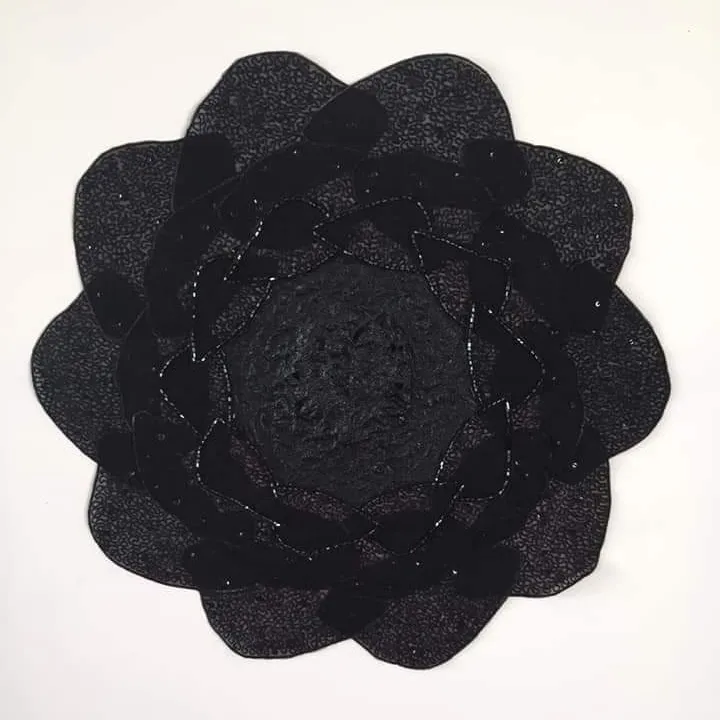
Laid in a meandering line they make vermicelli, the classic workshop filling. On my canvas Fleur noire, black sequins scattered on the petals make a black flower exist on a black ground: without their sparks, it would vanish.
Stitching beads with a needle: the core gestures
The method open to everyone, and the most precise. The repertoire holds in five gestures, each with its use:
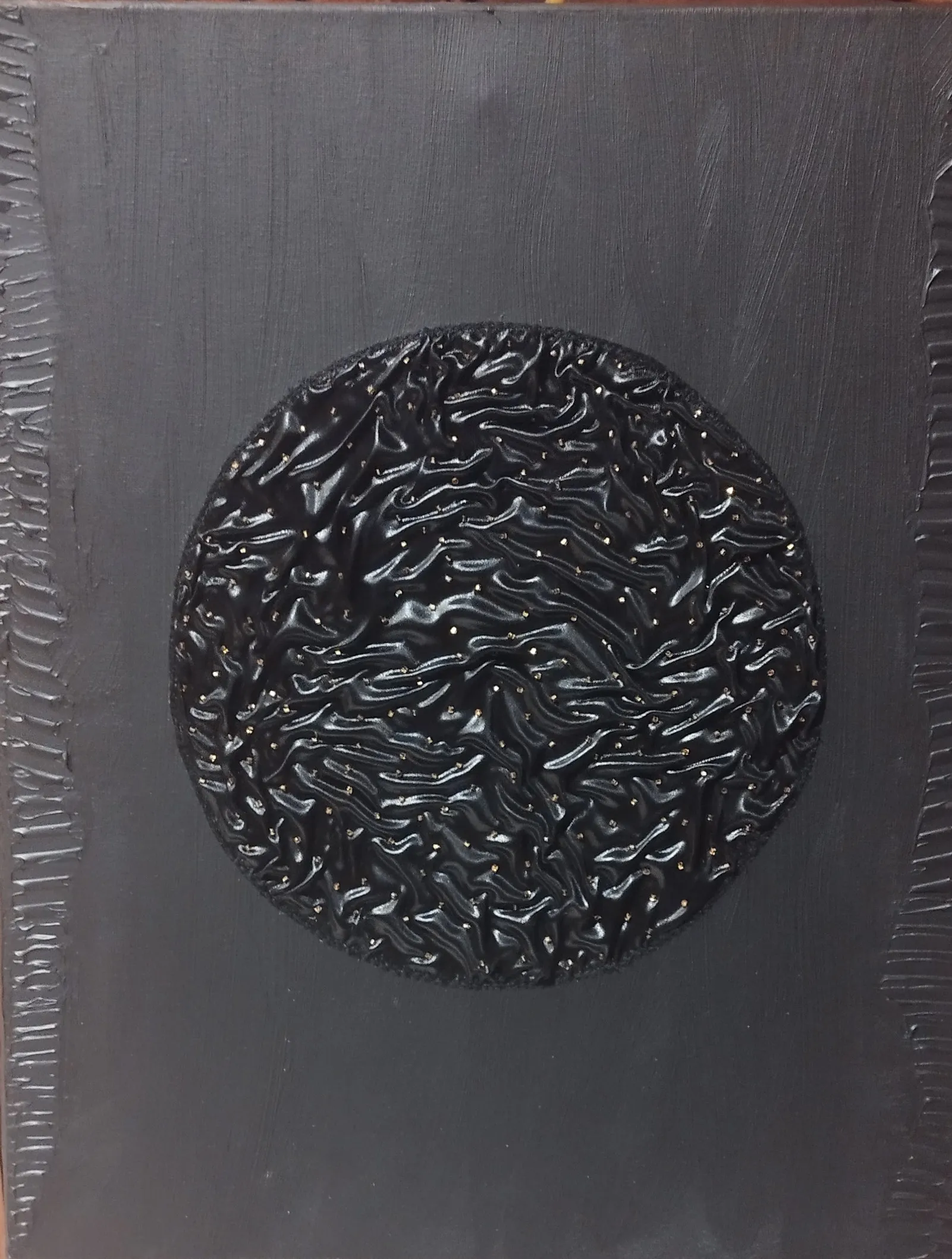
- One by one, with a doubled return: the strongest placement, one bead per stitch, stitched through a second time. That is how the gold beads are sewn into the folds of Satin noir, and the hundreds of pink beads circling Soleil rouge.
- Backstitch by twos or threes: string two or three beads, stitch down, come back through the last one. Faster, solid enough, the placement for lines.
- The couched row: one thread carries all the beads of the row, a second thread ties it down between beads, every two or three. The placement for long curves and outlines, like the bead rows edging the petals of Singapour.
- The stop bead: a large bead held by a small one, the thread rising through the first and blocked by the second. For beads standing upright.
- Bugles: laid end to end like pen strokes; always check the edge, sometimes sharp, which wears the thread.
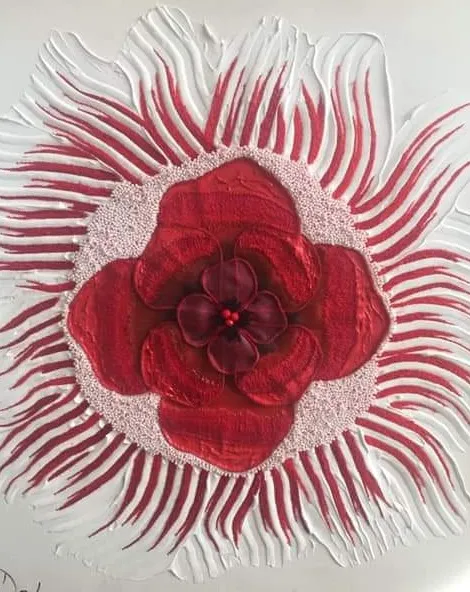
Red Sun: hundreds of beads, set one at a time
Couture beading: pre-strung beads and the Lunéville hook
Here is the method almost nobody explains, the one used in haute couture embroidery workshops. The beads are first pre-strung onto the working thread, in hanks. The fabric, stretched on a frame, is worked from the back: the embroiderer does not see the beads, which hang below the work. With each stitch of the tambour chain stitch made with the Lunéville hook, one bead is brought up against the fabric; the chain advances, and the beads line up in a regular file on the other side. The left hand feeds, the right hand hooks, and the gesture becomes a flow: where the needle places one bead, the hook places ten. It is for that speed, that hand-made machine regularity, that workshops like Lesage have beaded with the hook for more than a century. The entry price: working blind, and unpicking the whole file if one stitch lets go.
Threads, needles and the durability of bead embroidery
Thread is the weak point of all beading: it rubs inside glass holes at every pass. Glazed or waxed cotton, doubled sewing polyester, or dedicated nylon beading threads; in every case, wax the thread and renew it often. The needle must pass twice through the smallest bead of the project: test before starting, not mid-row. Durability is decided at the anchors: fasten off every few centimetres rather than at the end of the row, so a snag can only ever free a handful of beads. Beaded embroidery is never washed; it is dusted, as explained in the article How to frame embroidery.
Bead embroidery in my canvases
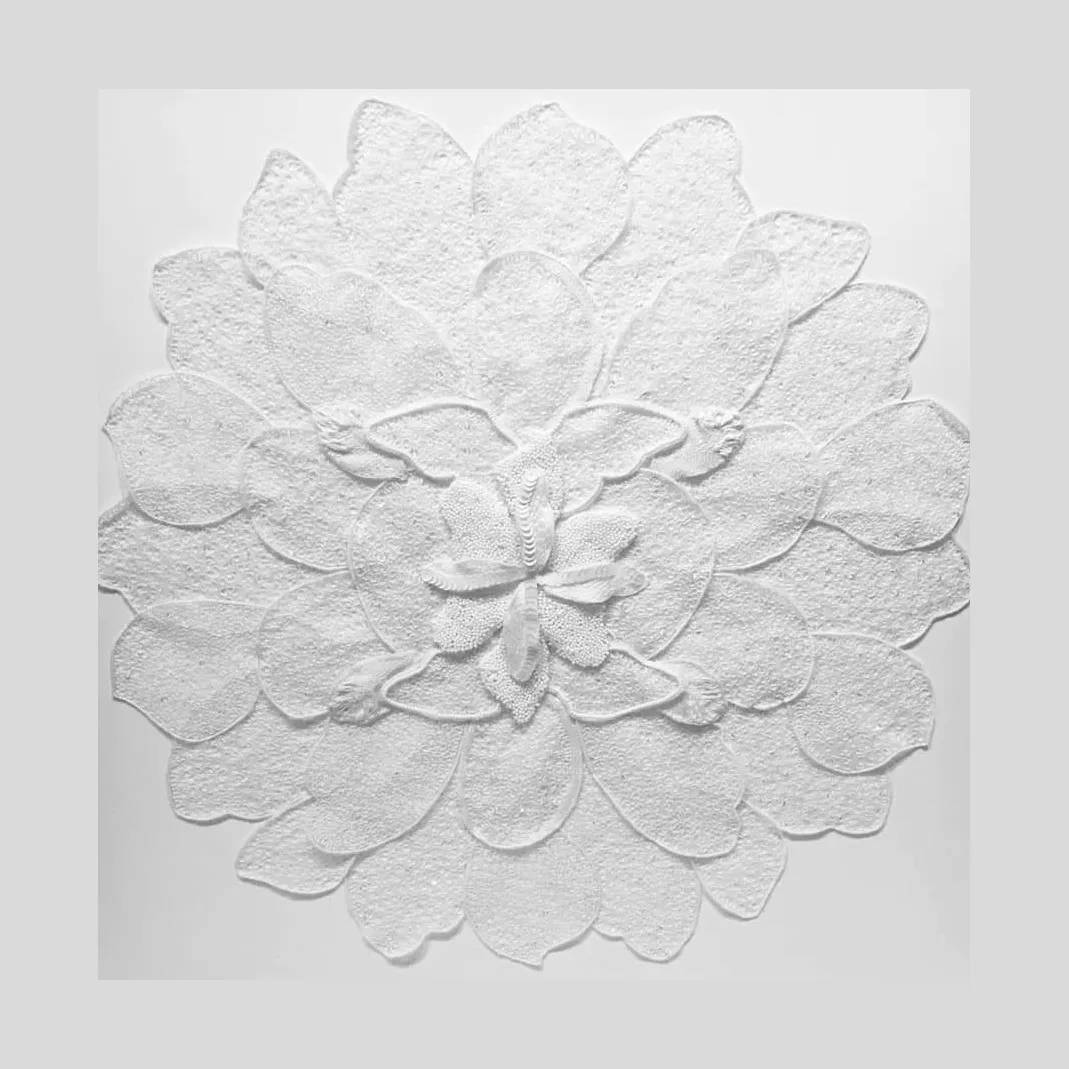
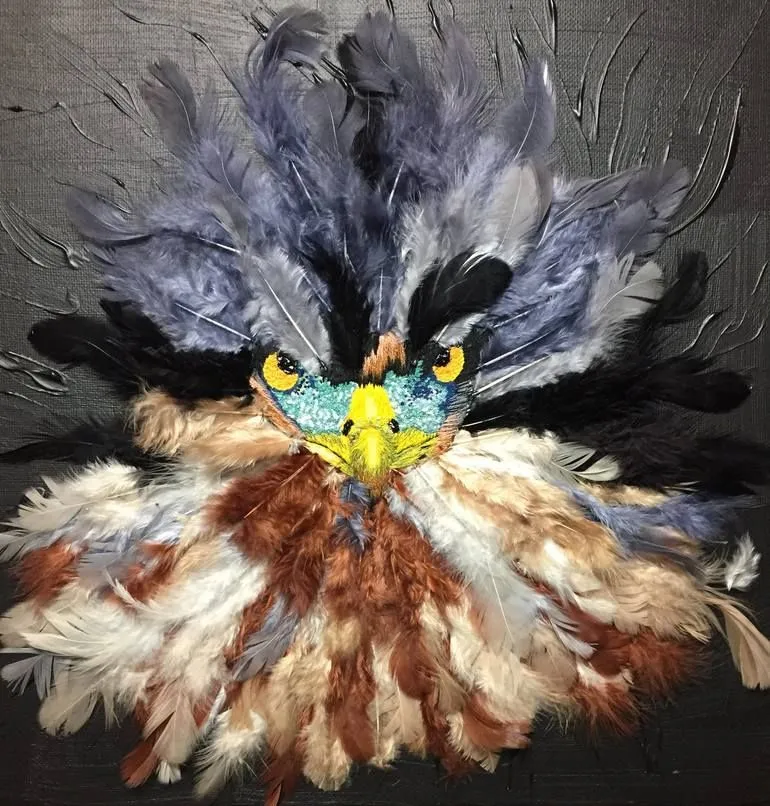
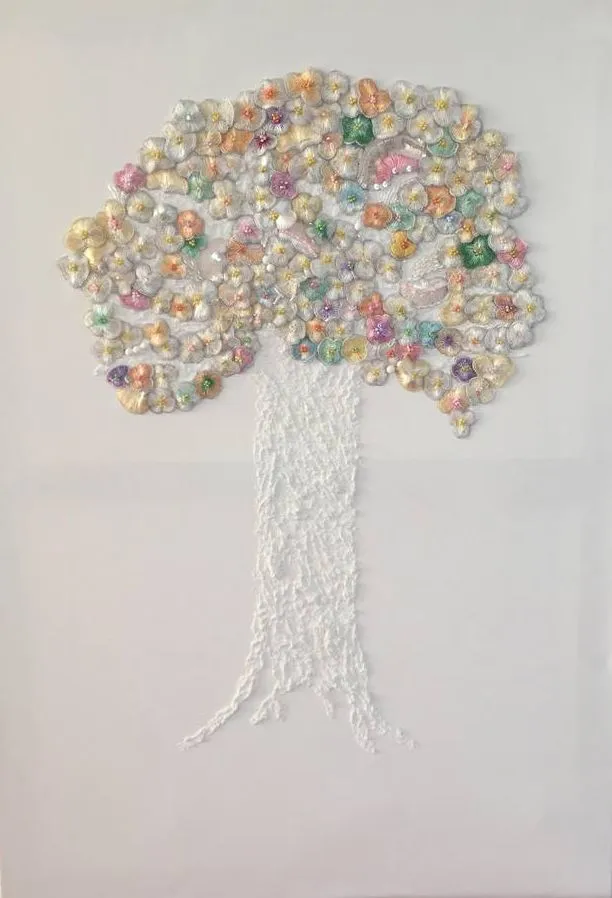
On a canvas hung on a wall, the bead changes role: it no longer decorates a moving garment, it fixes light inside a still image. The chest of Edwige glitters with silver beads under feathers studded with sequins; Dame blanche is scattered with tiny beads, placed to be sensed rather than to shine; the petals of Fleur blanche are covered in white sequins and beads down to the very last one, a white that lights up as you walk past. Three uses, three densities: the bead matters less than the exact place where it stops.
Questions people ask
What is the difference between needle bead embroidery and tambour beading? Needle bead embroidery places beads one by one or in small groups, working from the front of the fabric: slow, precise, open to anyone. Tambour beading works from the back, with pre-strung beads fed continuously by a chain stitch made with a Lunéville hook: it is the couture workshop method, roughly ten times faster on large surfaces.
Which beads should you choose for bead embroidery? For bead embroidery, Czech seed beads are slightly irregular and give a lively surface; Japanese beads (Miyuki, Toho) are highly calibrated, with a larger hole that forgives double thread passes; delicas, cylindrical, fit together like bricks. Choose by effect: regularity for graphic lines, irregularity for surfaces that catch light from everywhere.
How do you sew sequins in embroidery? A sequin in embroidery is sewn four ways: with a visible stitch through its hole, with an invisible stitch hidden under the next overlapping sequin, locked by a small seed bead sewn at its centre, or laid in overlapping rows like fish scales. In couture, the Lunéville hook chains them on pre-strung, from the back.
Which thread should you use for bead embroidery? For bead embroidery, use a strong, fine thread: glazed or waxed cotton, doubled sewing polyester, or a dedicated nylon beading thread. The thread must pass twice through the smallest bead, survive the sometimes sharp edge of glass beads, and stay discreet; wax it to limit wear and knots along the way.
The artist behind Fra-Del trained at the Lesage school in Paris and beads with both needle and Lunéville hook, on canvas. About Franck Delorme, embroidery artist →
The artworks that use this technique
Discover the works to come
Leave your address and we will let you know whenever a new work is under way or finished.