Goldwork embroidery: why gold thread is couched, not stitched
August 11, 2026
Contents
Real gold thread contains very little gold. The classic passing thread, what French embroiderers call filé, is a hair-fine strip of gilded metal wound in a spiral around a silk core. It gleams like solid metal, and it behaves like what it is: a wrapped wire, springy, fragile at the surface, unwilling to bend twice in the same place. Almost everything strange and beautiful about goldwork embroidery follows from that one material fact.
What goldwork is
Goldwork is embroidery in metal thread: gold, gilt, silver, copper. What defines it is the material, not the color, and the material dictates the method. Where Lunéville embroidery runs and needle painting blends its gradients, gold imposes its own slowness. Ordinary embroidery pulls its thread through the fabric thousands of times. Goldwork, for the most part, does not pull its thread through the fabric at all.
Couching: why goldwork stays on the surface
Take a needle, thread it with passing thread and try to embroider normally. Within a dozen stitches the metal wrapping cracks at every bend, the eye of the needle shaves it off the silk core, and the fabric shows scars where the stiff wire forced its way through. The thread that cost the most in your workbox is destroyed by the gesture that ordinary thread survives millions of times.
So goldwork inverts the logic. The gold is laid on the surface, following the drawn line, and fixed there by something else: tiny stitches of fine waxed silk, placed at regular intervals across the gold, so discreet that from arm’s length the metal seems to hold itself. This is couching, in French couchure, literally “laying down.” The fine silk does all the traveling through the fabric; the precious metal never goes below.
The reasons stack up neatly:
- The thread survives. Laid and never bent through the weave, the metal keeps its wrapping and its shine for centuries. Church vestments several hundred years old still gleam.
- The fabric survives. No stiff wire sawing at the weave.
- No gold is wasted. A stitched thread spends half its length hidden on the back of the work. In gold, that half is money buried in the dark. Couching keeps every centimetre of metal on the visible face.
- The line stays free. A couched thread can spiral, hairpin and fill shapes edge to edge, because the silk fixes it wherever you decide. A needle-borne wire could never turn so tightly.
Medieval England briefly did it the other way. The technique called underside couching, the glory of Opus Anglicanum, pulled a tiny loop of the gold to the back at each fixing point, hiding the linen thread completely and making the surface flexible as cloth. Cathedral inventories across Europe fought over the work; an embroiderer trained eight to ten years before touching commissions. But every loop buried gold and multiplied hours, and by the fifteenth century surface couching had won. Economy shaped the craft as much as beauty did.
Two families of gold thread
Every catalogue of goldwork materials looks like a jewelry drawer emptied on a table: passing, purl, pearl purl, plate, twist, spangles. The list stops being confusing the moment you see that it folds into two families, split by one question: is the thread continuous, or cut?
| Family | Members (EN / FR) | How it is applied |
|---|---|---|
| Continuous threads | passing thread / filé ; pearl purl / jaseron ; plate / lame ; twists / torsades | Laid on the surface in unbroken lengths and couched down |
| Cut threads | purl / cannetille (smooth, matte, bright, check) | Cut into short segments and threaded like beads, sewn through their hollow core |
The second family deserves the explanation it never gets. Cannetille (English purl) is not a thread at all in the usual sense: it is a fine metal wire wound into a tight spring, producing a flexible hollow tube. The embroiderer cuts the tube into segments of a few millimetres with scissors reserved for metal, picks each segment up on the needle exactly as if it were a bugle bead, and sews it down through its own hollow center. Massed segments laid in changing directions produce the crushed-light sparkle that photographs of military badges never quite capture. Its stiffer cousin jaseron (pearl purl) keeps the coiled look, resembling a row of minute beads, and goes back to the first family: laid whole and couched invisibly between its coils.
One material, two logics: what is continuous is couched, what is cut is beaded. Hold that sentence and every goldwork supply list becomes readable.
Or nué: painting with shadow on gold
The most demanding branch of goldwork treats the couching stitches themselves as the image. In or nué, “shaded gold,” pairs of gold threads are laid side by side across the entire motif, and the couching is worked in colored silks. Where the silk stitches crowd together, the color covers the metal; where they spread apart, the gold blazes through. Faces, drapery, whole scenes emerge from nothing but the spacing of tiny stitches over a golden ground. The Burgundian court of the fifteenth century pushed it to its summit in the vestments of the Order of the Golden Fleece, embroideries regularly compared to panel painting. It remains the slowest technique I know of in any embroidery tradition: centimetres per day, at full concentration.
The history of goldwork: three clients, seven centuries
Goldwork’s history is easiest to follow through the three clients who could afford it.
The Church came first. From Opus Anglicanum onward, gold vestments were medieval Europe’s diplomatic gifts and its most portable wealth. The army followed: epaulettes, badges of rank and ceremonial uniforms, a tradition France maintained through specialized workshops, and which survives at the Bégonia d’Or atelier in Rochefort, the last French house still doing official military goldwork. Couture inherited the rest. The great Parisian embroidery ateliers, Lesage first among them, keep goldwork in the haute couture collections season after season; it is taught at École Lesage in the same progression as a century ago. That is where I learned to handle metal thread, and the first lesson is humility: the material decides, you follow.
Gold thread in my work
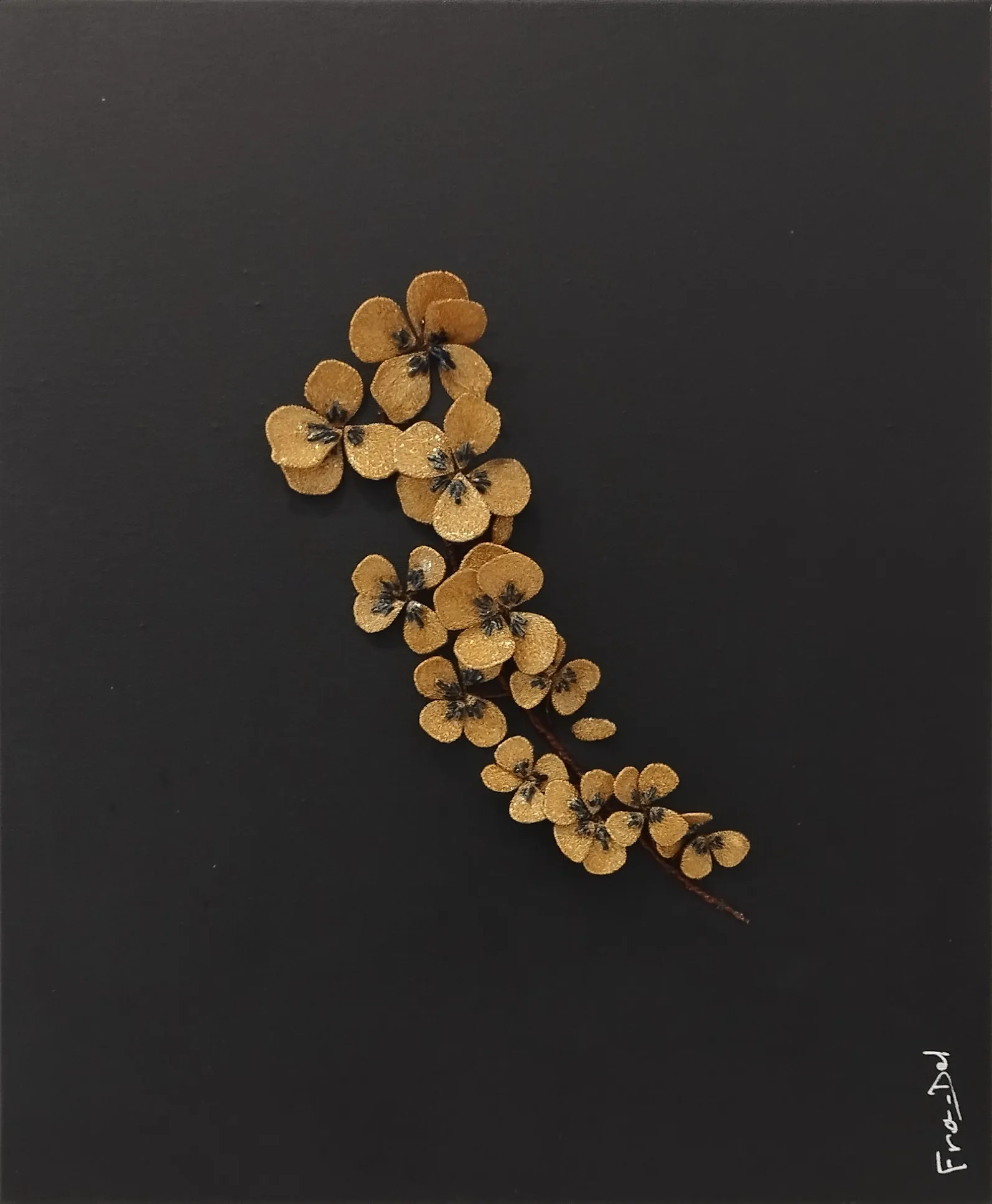
My own use of gold is unorthodox, and I say so plainly. Classic goldwork couches its metal onto silk or velvet. I work gold thread with the Lunéville hook into petals of chain stitch, build them into flowers, and varnish them: the pieces Fleurs dorées and Arbre, fleurs dorées are made this way, gold chain-work stiffened into permanent bloom. The varnish is not only sculptural. Most modern “gold” threads are gilded copper or silver, and unprotected they tarnish over years; sealed, the shine is fixed. A conservator of historical vestments would frown at the method. On a canvas meant to hang in daylight for decades, I will take the frown.
If you are starting out, start classically: a small couched shape in passing thread, a filling of cut cannetille segments, on a frame stretched drum-tight. You will learn in one evening why every rule in this article exists, because the material enforces them itself.
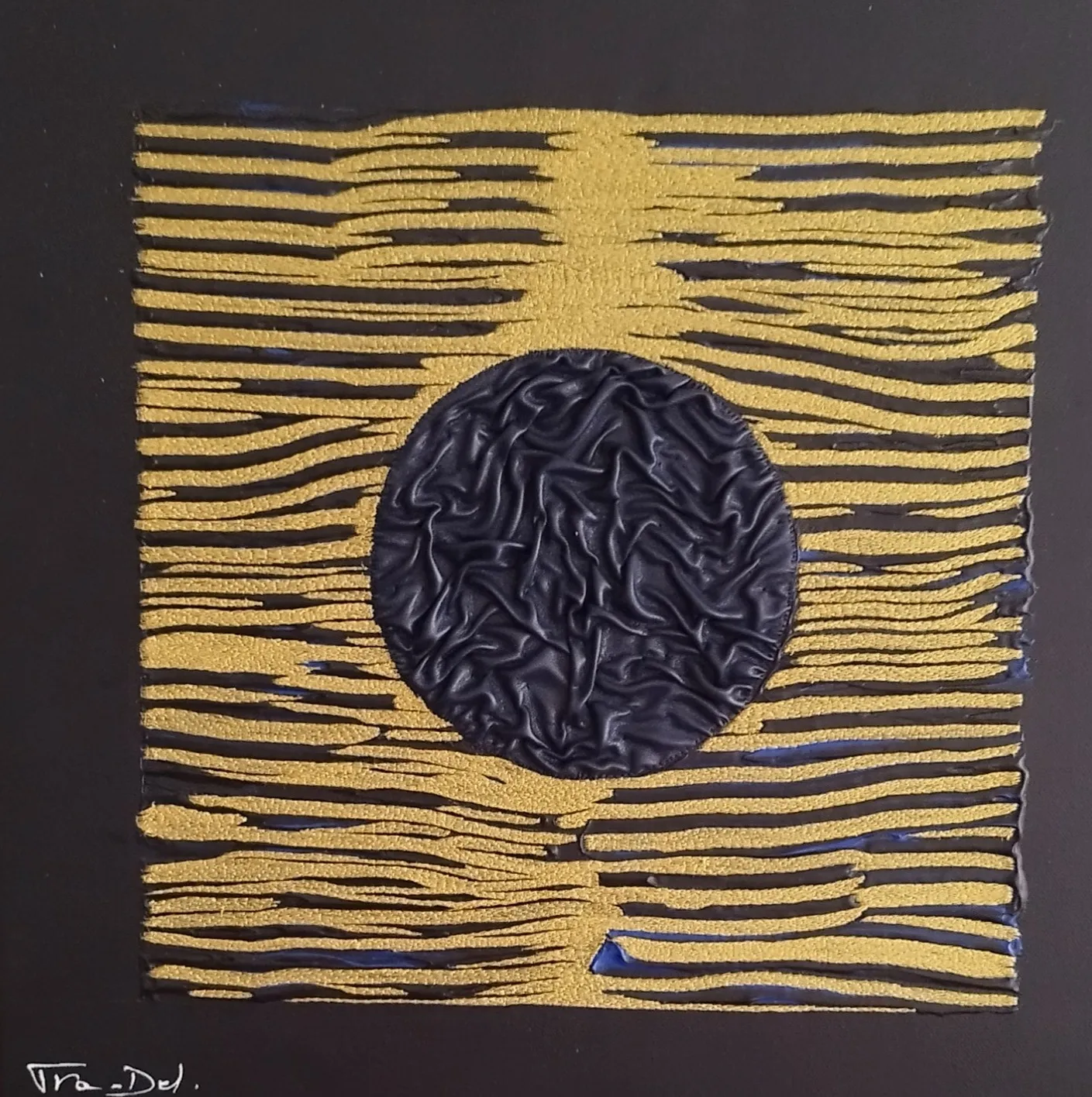
Golden Sun: gold laid with the hook, row after row
Questions people ask
Why is gold thread couched instead of stitched through the fabric? Gold thread is couched because it is a metal strip wound around a silk core: pulled repeatedly through fabric, the metal kinks, frays and strips off its core, and it damages the fabric on the way. And gold hidden on the back being wasted, all of it stays on the surface, held by fine waxed silk.
What is cannetille (purl)? Cannetille, called purl in English, is a hollow metal tube made by winding a fine wire into a tight spring. It is not couched: it is cut into short segments, threaded onto the needle like a bead, then sewn down through its own hollow core. French cannetille and English purl are the same material.
What is the difference between cannetille and jaseron (pearl purl)? The difference between cannetille and jaseron is stiffness: both are coiled metal wires, but cannetille is soft and hollow and gets threaded like a bead, while jaseron, the stiffer coil known in English as pearl purl, looks like a row of tiny beads and is laid whole, couched down between its coils.
What is or nué in goldwork embroidery? Or nué is the goldwork technique in which pairs of gold threads are laid side by side across the whole motif and couched down with colored silk. Where the silk stitches are dense, the color reads; where they are sparse, the gold shines. The image is painted entirely by the spacing of the stitches.
The artist behind Fra-Del trained at École Lesage in Paris and works Lunéville crochet, gold thread and needle painting on canvas. About Franck Delorme, embroidery artist →
The artworks that use this technique
Discover the works to come
Leave your address and we will let you know whenever a new work is under way or finished.