Embroidery on leather: the technique, and leather as an art material
August 12, 2026
Contents
- Why embroidery on leather is unlike any other
- Choosing your leather for embroidery
- The tools of embroidery on leather
- Embroidering leather by hand, step by step
- Embroidering leather by machine
- Sewing leather onto canvas: leather as an art material
- Caring for and rescuing embroidery on leather
- Questions people ask
Fabric forgives everything, leather forgives nothing: in a weave, the threads part around the needle and close again; in leather, every hole is a permanent cut in a solid material. All of embroidery on leather follows from that sentence. Here is how to embroider this material that forgets nothing, by hand and by machine, and then what becomes possible when you stop decorating it and start sewing the leather itself onto canvas, as an art material.
Why embroidery on leather is unlike any other
A fabric is a grid of threads; leather is a dense felt of collagen fibres, with no warp or weft. The direct consequences: the needle cannot push fibres aside, it has to cut them, which calls for a blade point; the hole never closes, which rules out clean unpicking and improvised stitching; and a line of holes placed too close pre-cuts the leather like a postage stamp. On leather, everything is decided before the first stitch: the design, the density, the spacing.
Choosing your leather for embroidery
- Supple lambskin and calfskin are the ideal ground: thin enough for the needle, dense enough to hold the stitch.
- Thick leathers (saddlery, vegetable-tanned) can only be embroidered by hand, holes prepared one by one; no domestic machine punches through them cleanly.
- Very thin lambskin tears between the holes: reduce density further, or back it with interfacing.
- Faux leather is more forgiving and tolerates denser designs; it remains a different material, with a different hand.
- Textured and flocked leathers, my favourites, add one more variable: their surface (flocked velvet, grain, folds) is part of the image, and the embroidery has to work with it rather than cover it.
The tools of embroidery on leather
Three tools change everything, and none is expensive:
- The leather needle, with a wedge point (80/12 for most leathers): its blade tip cuts a clean little slit instead of forcing a round hole. A universal needle tears; a leather needle incises.
- The awl (or a 0.5 mm punch) for hand work: every hole along the design is opened before embroidering, at regular spacing. The needle no longer pierces, it follows.
- A thread that survives: sewing polyester or waxed linen for anything handled, stranded cotton for pure decoration. The edge of each hole wears the thread at every pass; waxing helps, doubling reassures.
For machine work, add a cut-away stabilizer, never a tear-away, which would rip the line of holes open.
Embroidering leather by hand, step by step
- Draw the design on the back, or on tissue paper laid over the leather; never pencil on the grain side.
- Pre-punch all the holes with the awl, at constant spacing: that gesture makes the final regularity, not the stitching.
- Embroider with the stitches leather likes: backstitch for clean lines, stem stitch for curves, spaced straight stitches for airy fillings. The full repertoire is in the article Embroidery stitches.
- Keep the tension low: leather does not relax like fabric, and an over-tight stitch embosses the surface forever.
- Fasten off on the back with flat knots, without passing through again.
What not to do: dense fillings. Tight satin stitch on thin leather commits both faults at once, the continuous perforation line and the massive tension.
Embroidering leather by machine
The essentials come down to four settings: a reduced density (space out satin columns, open up the fills), with a design built for leather rather than a fabric design transposed; never hoop leather directly, since hoop burn is as permanent as the holes (float the piece on adhesive or use a magnetic frame); a cut-away stabilizer; and a slow speed, around 350 stitches per minute. Everything else obeys the same laws as hand work: the hole is permanent, density is the enemy.
Sewing leather onto canvas: leather as an art material
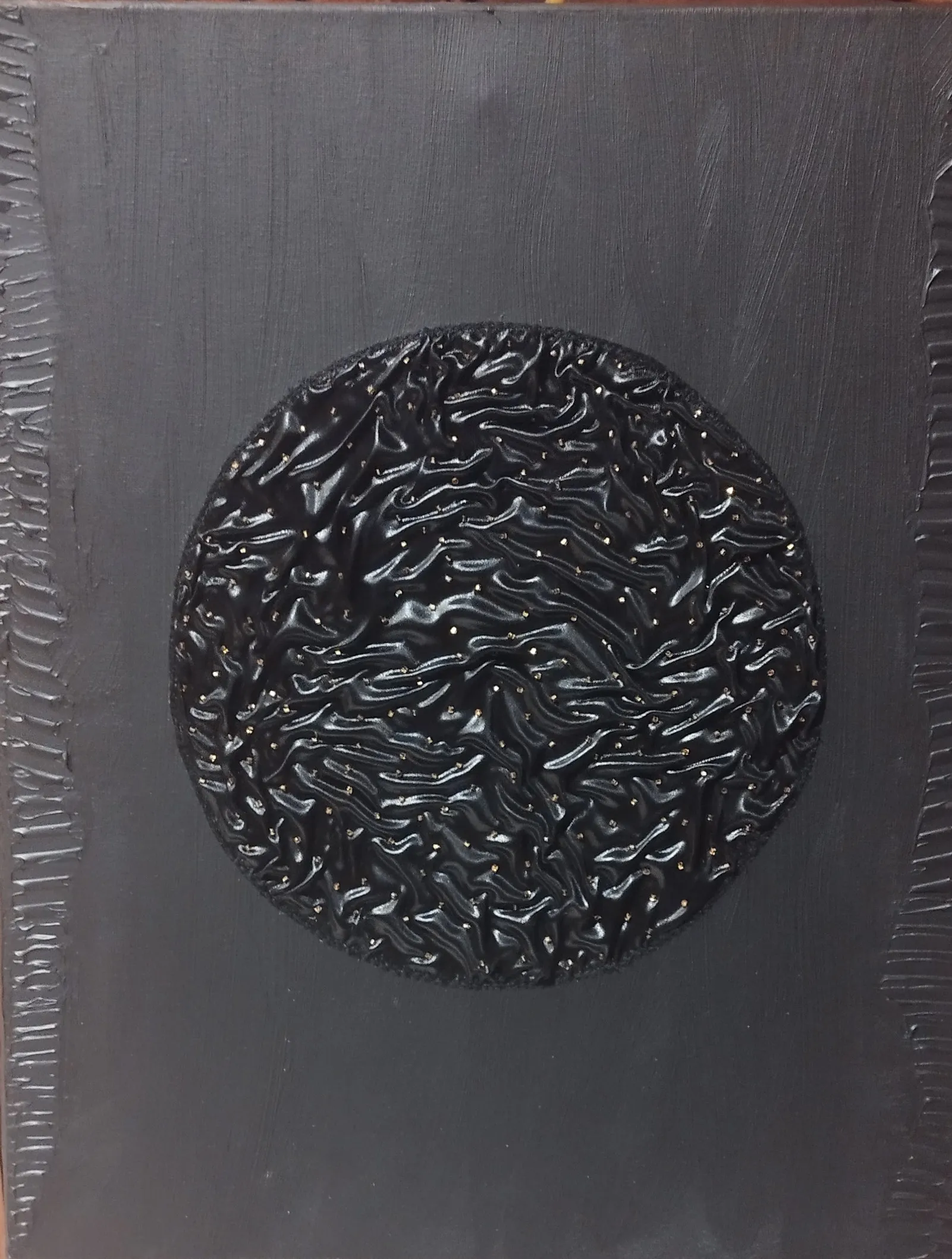
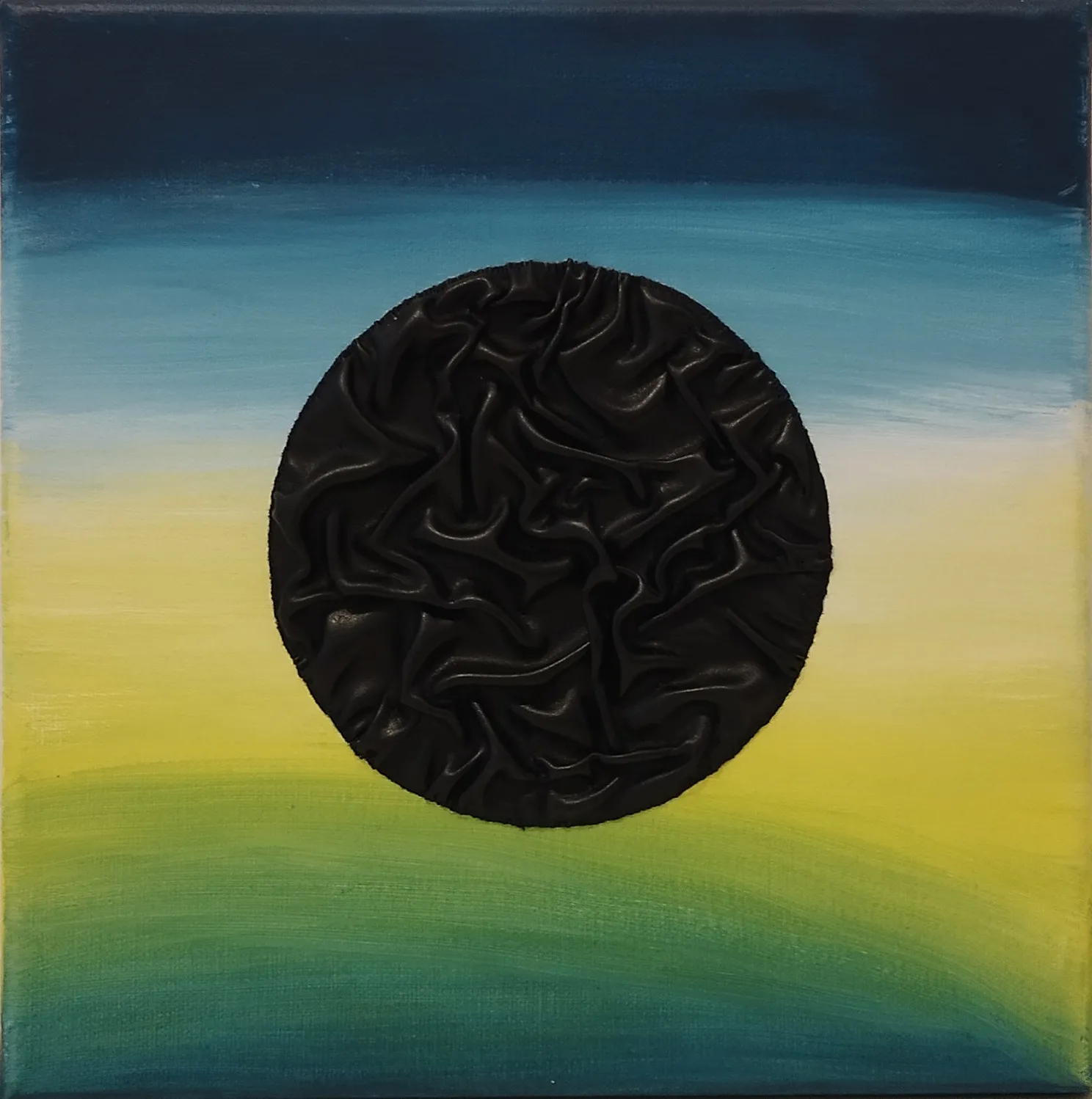
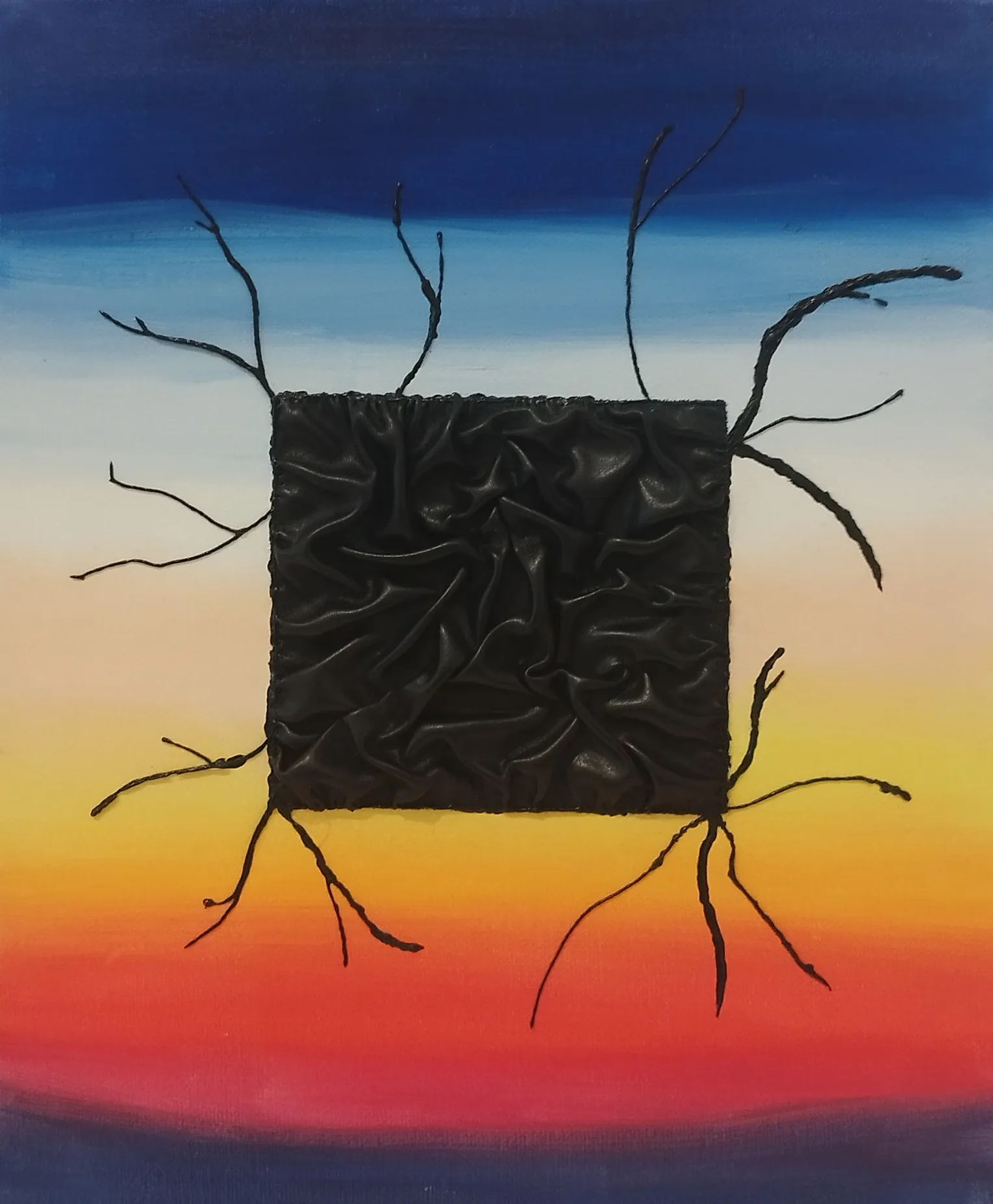
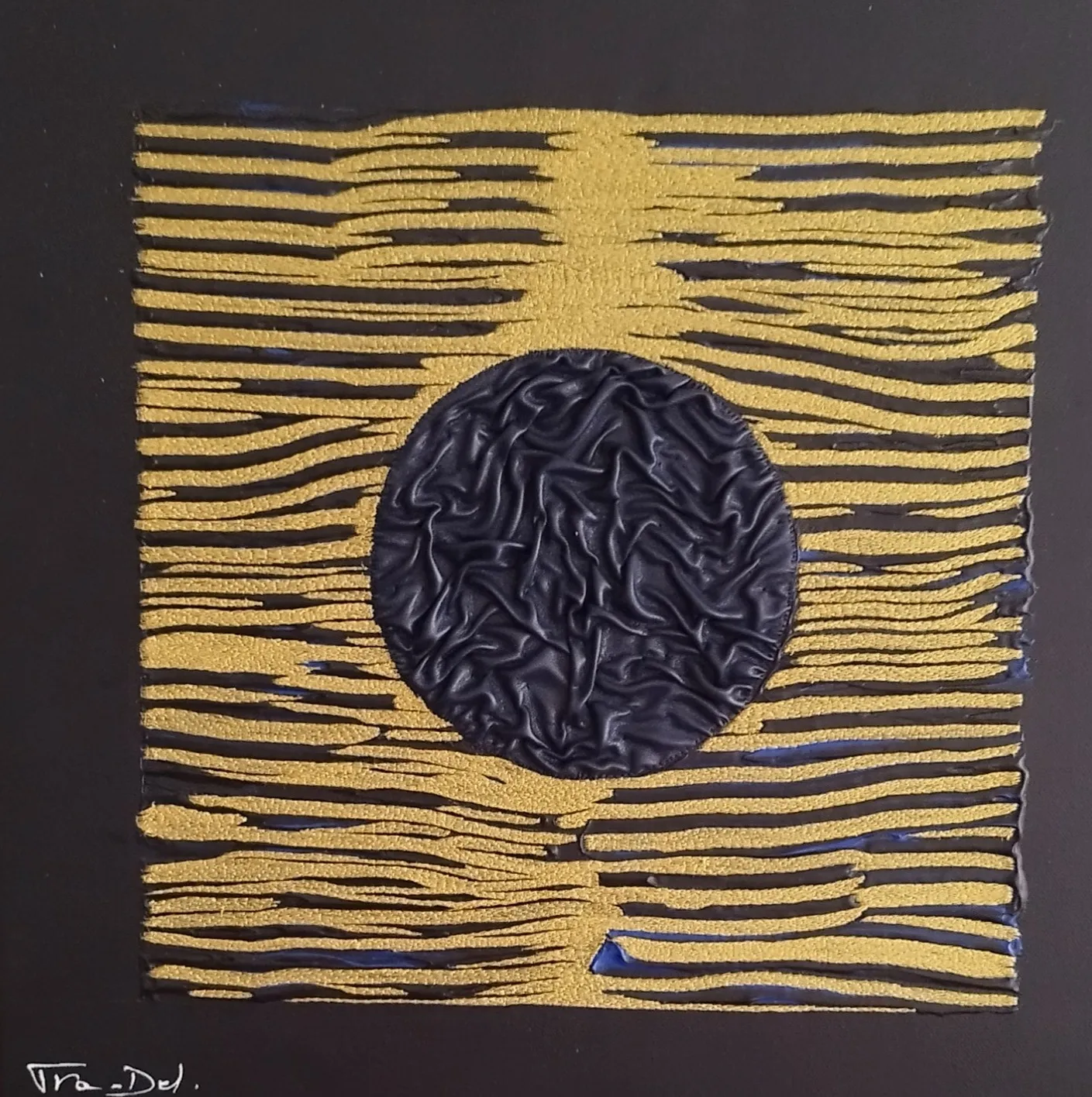
Here is the reversal that occupies me: instead of embroidering a motif onto a leather object, sewing the leather itself onto canvas, as raw material for the image. Leather brings what no thread can give: deep folds, mass, a muted light. A square of brown flocked leather gathered at its edges becomes a frozen drape that changes with the hour (Cuir marron); a disc of crumpled black leather absorbs a painted gradient (Soleil noir); the same black, seeded with gold beads sewn one by one into the folds, becomes a starry night of matter (Satin noir); and a dark flocked leather circled with gold rays laid with the Lunéville hook makes an inverted sun (Soleil doré).
Technically it is appliqué: the leather is gathered or crumpled into the wanted shape, then sewn to the canvas with stitches hidden inside the folds, where the thread disappears into shadow. All the rules of embroidery on leather still hold, the cutting needle, the spaced holes, the gentle tension; only the intention changes. The leather is no longer the support of the embroidery: it is its subject.
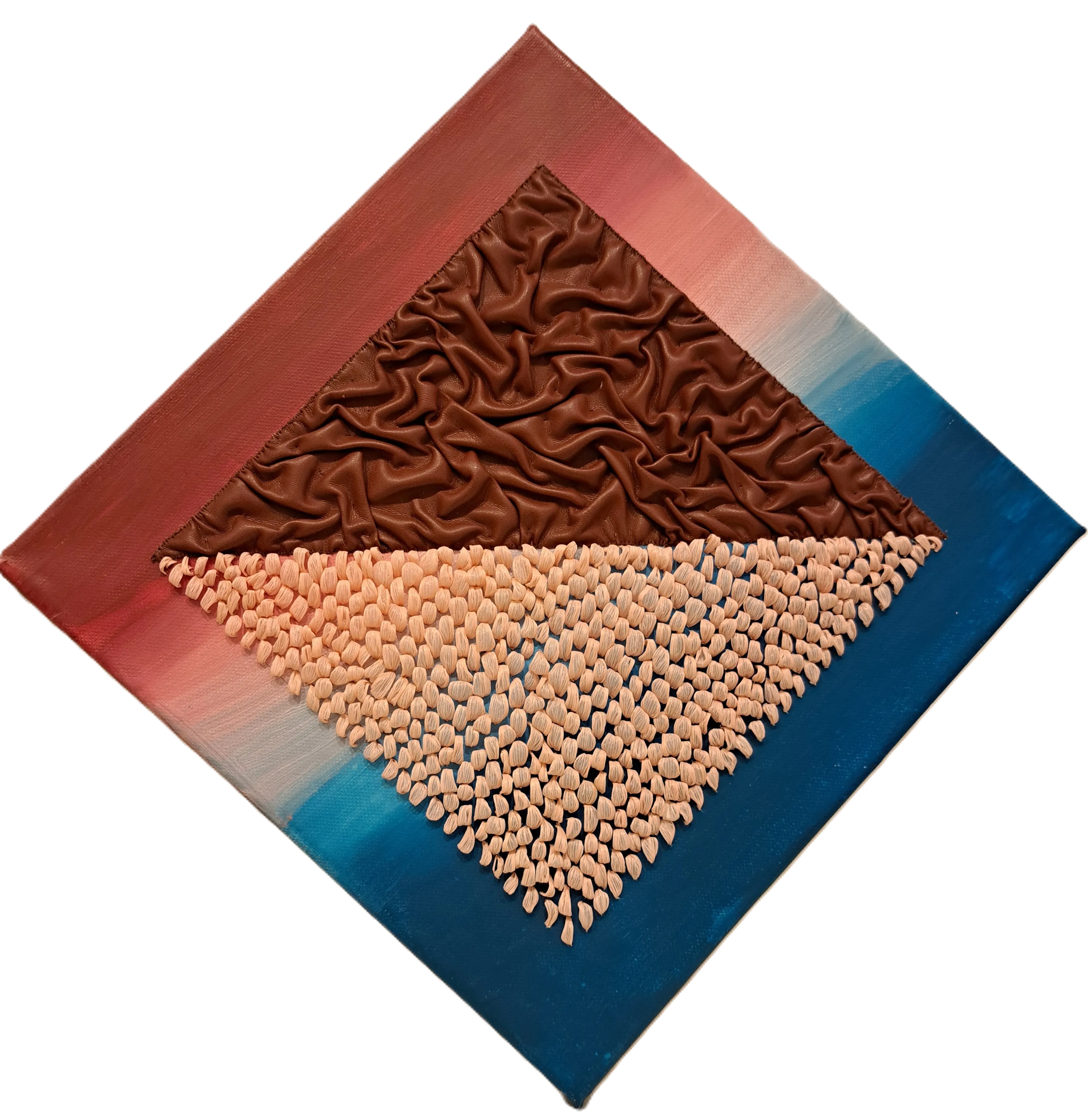
Leather sewn onto canvas, treated as a painter’s material
Caring for and rescuing embroidery on leather
Embroidered leather is cared for like leather, while avoiding the stitches: a nourishing balm applied around the motif, never over it, since thread dislikes grease. No direct sunlight, which dries the leather and fades the thread. If a thread breaks, replace it by following the existing holes, never by punching new ones beside them. And if the embroidery has to go, unpick it and accept the trace: the perforations soften with balm and massage, they do not vanish.
Questions people ask
Does embroidery weaken leather? Well-planned embroidery does not weaken leather, but a line of holes placed too close together pre-cuts it like a postage stamp: the leather can tear along the motif. The rules are to space the perforations, reduce stitch density, and avoid dense fillings such as tight satin stitch on thin leathers.
Can you remove embroidery from leather? You can unpick embroidery from leather, but the holes remain: leather does not close back up the way a woven fabric does. After removing the thread, the perforations can be softened by feeding the leather with balm and massaging it warm, without ever disappearing. Hence the rule: on leather, embroider only a settled design.
Which thread should you use to embroider leather? To embroider leather, choose a thread that survives the rubbing of the holes: sewing polyester or waxed linen for strength, stranded cotton for a matt decorative effect on pieces that get little handling. Waxed thread slides better through the perforations and marks the leather less; double it on items that will be worn.
Can you embroider leather by hand without a machine? Yes, leather embroiders very well by hand without a machine, and past a certain thickness it is the only option, since domestic machines no longer punch through cleanly. The key is pre-punching: an awl or a fine punch opens every hole along the design line, and the needle then simply follows the prepared path.
The artist behind Fra-Del trained at the Lesage school in Paris and sews flocked leather onto his canvases. About Franck Delorme, embroidery artist →
The artworks that use this technique
Discover the works to come
Leave your address and we will let you know whenever a new work is under way or finished.