Feather embroidery: sewing real feathers into an embroidered work
August 16, 2026
Contents
A feather is the only material an embroiderer applies without being able to improve it: it arrives finished, iridescent, structured, designed by a savoir-faire that is not his own. All he can do is respect it, choose it well, and sew it well. That is exactly this article’s subject, with one clarification first: this is about real feathers, not the feather stitch, that classic thread stitch which only draws feather-like lines. Here is what plumasserie is, what I owe it and what separates me from it, where feathers come from today, and how a real feather is sewn into embroidered work, gesture by gesture.
Plumasserie, a craft of its own
Plumasserie is the French craft of the feather itself: not sewing it into embroidery, but preparing it. The plumassier degreases the raw feather, dyes it, reshapes it with steam, curls it with a knife (the barbs drawn over a blade, the way you curl a ribbon), trims it, then mounts it into ornaments, flowers and boas. The savoir-faire lives in a few houses, Lemarié first (founded 1880, today with Chanel at le19M), alongside Legeron and Février, and in a handful of independent artisans: only a few dozen plumassiers are thought to remain in France, mostly trained by the craft’s single vocational diploma. It is one of the most endangered and most admired crafts of haute couture.
Embroidering with feathers: a different approach from plumasserie
I am not a plumassier: I am an embroiderer who uses feathers. The distinction is not modesty, it is a definition. The plumassier transforms the feather; I take it as it is, prepared, and bring it into an embroidered composition, among threads, beads and paint. What embroidery gives the feather: a context, an image, neighbourhoods of materials that a pure ornament does not offer. What the feather gives embroidery: a living relief, an iridescence and a lightness of movement no thread can imitate. The two crafts salute each other; they do not merge.
Which feathers for embroidery, and where do they come from?
Each species has its use: goose and duck give sturdy feathers that take dye well; rooster brings sheen and curve; pheasant offers natural patterning, designed at the source; ostrich makes volume and mist. The question of origin matters as much as the species: today’s feathers come from food-chain farming, and protected wild species are banned under the Washington Convention (CITES). It is a hard line: a serious supplier names the species and the origin, and anything glittering with undocumented exoticism should stay where it is. My feathers come from those farming circuits, chosen one by one for their markings.
Sewing a real feather into embroidery
Here is the gesture almost nobody describes. A feather holds by its axis: the quill (calamus), the bare hollow base, which continues as the rachis between the barbs.
- Place it last. The feather is fragile; it arrives on the work when all the neighbouring embroidery is finished, never before.
- Couch the quill. The bare base is laid on the fabric and fixed like couching: several stitches across it, in a strong matching thread, holding the axis flat without splitting it.
- Lock between the barbs. The thread moves up along the rachis and passes once or twice just above the first barbs, where it disappears into the down. That upper stitch is what stops the feather from pivoting.
- Three or four passes are enough; more crushes the feather without holding it better. Textile glue is only a spot reinforcement on the quill, never the main fixing.
- Hide the fixing under a bead, a French knot or a neighbouring element: the feather should look placed, not tied.
- Respect the direction. Feathers overlap as they do on the bird, each row hiding the fixing of the one before; and barbs crushed during the work straighten with a breath of steam, held at a distance.
Edwige: real feathers and pleated satin, white on white
Feathers in my embroidered canvases
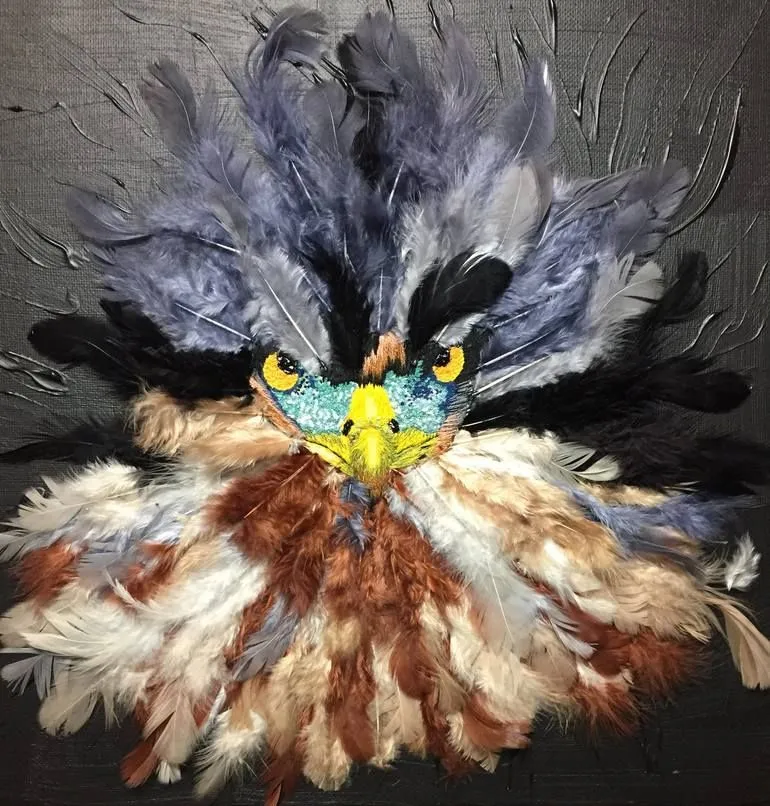
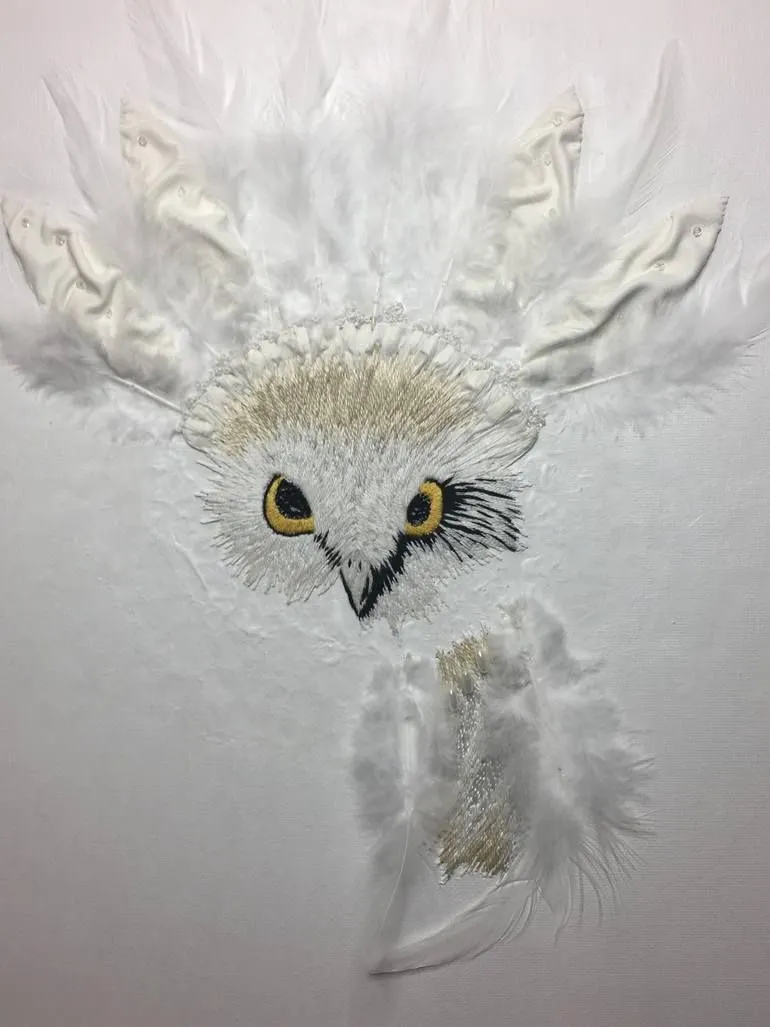
Two of my canvases owe everything to this gesture. Rapace wears a full plumage of real feathers, blue-grey in the crown, russet and cream on the chest, placed one by one around a mask embroidered in beads; the bird gets its presence from the mix, thread for the gaze, feather for the living. Edwige, the snowy owl, blends the registers: real feathers in the crown, pleated satin feathers studded with sequins beside them, and a chest of silver beads. Up close you can see the border between the sewn and the living; three steps back it disappears, and that is exactly the effect I am after.
Does a work with feathers last?
Yes, on three conditions, because a feather is keratin, the same material as hair: it lasts for decades if protected from its three enemies. Direct light, which fades its colours faster than thread; humidity, which deforms it; moths, which eat it like wool. In practice: a wall without sun, dusting with a breath of cold air, an anti-moth precaution in the room, and steam at a distance to straighten crushed barbs. Never water, never rubbing. The general rules for hanging are in the article How to frame embroidery.
Questions people ask
Is feather embroidery the same thing as the feather stitch? No, feather embroidery with real feathers and the feather stitch are two different things sharing one name. The feather stitch is a classic thread stitch that draws feathery, branching lines with no actual feather involved. Feather embroidery in this article’s sense means sewing real prepared feathers into an embroidered composition, among threads and beads.
Where do the feathers used in embroidery come from today? The feathers used today in embroidery and plumasserie come from farmed species of the food chain: goose, duck, rooster, pheasant, guinea fowl, ostrich. Protected wild species are banned under the Washington Convention (CITES) and trading them is illegal. A serious supplier always names the species and the origin of its feathers.
How do you sew a feather onto fabric? A feather is sewn onto fabric by its axis: the bare quill is laid down and fixed with several stitches across it, then the thread moves up to hide between the first barbs and lock the shaft without crushing it. Three or four passes of a strong thread are enough; the fixing then disappears under a bead or a stitch.
How do you care for embroidery that contains feathers? Embroidery with feathers is cared for like a fragile textile: never direct sunlight, which fades the colours, and no humidity; gentle dusting with a breath of cold air; anti-moth precautions, since feathers are keratin like wool. Crushed barbs straighten with steam held at a distance. Never wash it, never rub it.
The artist behind Fra-Del trained at the Lesage school in Paris and sews real feathers into his embroidered canvases. About Franck Delorme, embroidery artist →
The artworks that use this technique
Discover the works to come
Leave your address and we will let you know whenever a new work is under way or finished.